Bar High Not Only for Games but for Games as Popular Art
[Tale of Tales' (The Path) Michaël Samyn explores the interplay between games and existing media, urging developers to have a full understanding of precisely what the elements of the medium they're working in add up to.]
Frank Lantz in one case argued that games are non media -- because they "do not carry an idea from 1 place to another." I tend to concord with him. But I like to add that "video games are non games."
A Different Kind of Games
When it comes to traditional games -- board games and card games, every bit well equally children's games and fifty-fifty sports and dancing -- Lantz is clearly right.
Games found a set of conditions within which humans play. Any pregnant or message that comes out of the game is generated by the players, and was not enclosed in the game'southward design.
Video games take been similar to some of those traditional games for a long time. Simply there have always been remarkable differences. From the very showtime, many video games could be played by a person on their own. Many did not require opponents or partners, as most traditional games practice.

Some of the best traditional games accept no author.
(Girls playing Hide-and-seek. Photo past Jacques Lessard.)
Video games have too been almost exclusively designed on purpose by individuals or teams. While the origins of many of the best traditional games are vague and complex -- they are essentially authorless. And finally, at least for over a decade already, the presentation of video games on computers is frequently immeasurably more elaborate and sophisticated than annihilation we've seen in any of the other games, many of which can be presented through arbitrary tokens.
There's a tendency among developers to dismiss the visual presentation of a video game as "heart candy" or "skinning" or the evil necessary to appeal to a larger market. Simply what if we would take this presentation seriously instead? What if we expect at video games equally simulations of fictional realities, every bit representations of humans and their behavior, as aesthetic spectacles of images and sound and text and motion? Don't they start looking very similar to a medium and so?
A Medium Unlike the Others
To be sure, video games are a medium different any earlier. The central function of the role player and their ability to interact and alter the presentation, makes video games rather unsuitable for the kind of expressive or informative art that we are used to associating with media. But what if nosotros look at this chapters for alter as an opportunity rather than a restriction?
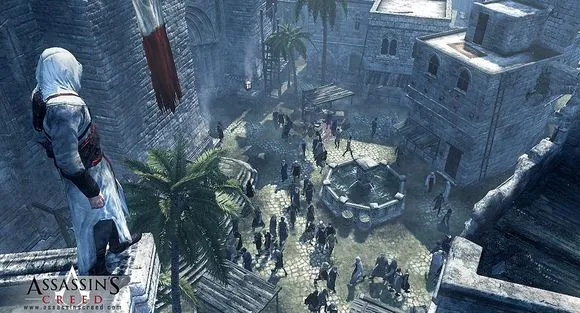
Edifice fictional worlds around the histrion.
(Assassin's Creed by Ubisoft)
Why would we want to tell a straightforward story like other media do? Have you seen a Hollywood picture show lately? All stories are the same, evidently. Why would we want to tell this same story once again? And what about the desperate attempts of the more than artistic directors and writers to cut their stories apart and brand absurd associations for the sake of escaping the terror of plot? Pathetic! But at least they empathise that there is a trouble. They just don't know that we take the solution.
And neither practice we, apparently.
Yet.
A New Media Experience
According to Lantz the term "medium" implies "something that carries data from a source to a destination." Only I think this as well materialistic and too functional a way of looking at media. Media are not just conduits for messages.
Non only do I doubt very much if artists really have some kind of clear message they're trying to convey in their music or their painting or their flick. But media as experienced by a member of the audience have very petty to do with data.
Who cares about the message of a high definition action film projected on a gigantic screen? Or nearly the goal of the composer when we are enjoying listening to his mass? Experiencing media is about what happens inside of me, and has very little to do with the source or the message or the medium.
Only even if media are every bit rigid and straightforward every bit Lantz suggests, why would they need to remain that way? It's non hard to imagine a medium radically changing nether impact of computer technology.
And it's equally quite likely that an entirely new medium emerges from this new technology, a medium that is as dissimilar from all the others as cinema was from painting and printed text from marble sculptures. In fact, it is difficult to imagine a new medium non evolving out of such a versatile technology!
A new medium, with new backdrop and new parameters. A new medium that demands a new attitude from the audience, a new style of interacting with it and "consuming" its "content" -- to use Lantz'due south terminology.
Resolving the Gridlock
I agree with Mr Lantz that games are not media. And developers, whose interests prevarication in games, would do well to avoid association with media considering information technology dilutes the play activity. But developers with an interest in the representational qualities of video games, in simulation and stories, should too heed his advice!
Because if games are non media, and one is yet interested in the media-qualities of video games, then it's probably a good thought to stay away from the traditional conventions of games.
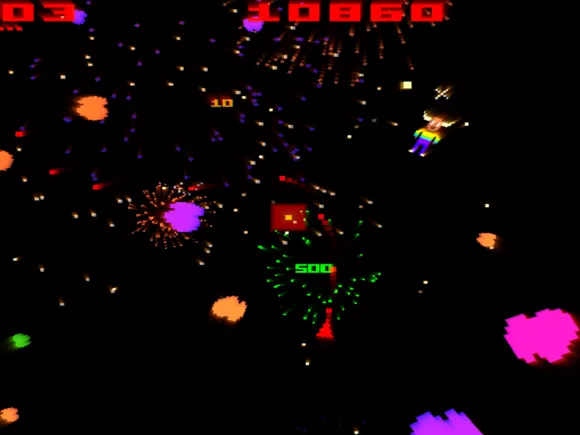
Video games that are not media are meliorate games.
(Minotaur Rescue by Llamasoft)
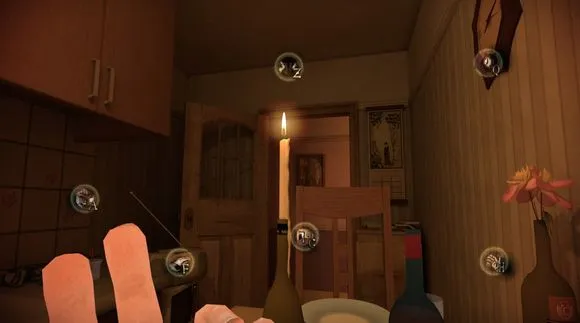
Video games that are not games are better media.
(Dinner Date by Stout Games)
Video games that are not media are better games.
Video games that are not games are better media.
I believe the primal to expanding the audience for video games lies in the acceptance and encompass by developers that video games -- dissimilar traditional games -- are media. The impressive graphical presentation of video games has lead to their enormous success. The hope of participating in a virtual earth holds irresistible appeal. But the discovery of rigid systems of game rules underneath the seductive spectacle turns all but the most persistent away.
Now, nosotros could be stubborn and insist that anybody merely become tough plenty to deal with the missions and tasks and grind we so carefully construct -- after all, we savour it, and then everyone must exist able to! Information technology's a matter of literacy, some would say. Or we could exist nice designers and effort to cater to people's expectations. If they can see such a wonderful thing in our medium, why tin can't we?
Onwards and Upwards
It's not that people don't like playing games. Merely when they turn to their adjacent generation panel or their souped-up PC for playing, information technology's non out of a want to collaborate with abstruse systems. It's because they want to be immersed in an emotional spectacle, they want to accept a ride through a fantastic landscape of sights and sounds.
And so give them that! Don't order them around to perform a certain task, exercise this or that mission, attain some goal, etc. Let them to live the fantasy. Gear up your metaphors free! Make the experience about the characters and their adventures! Don't arts and crafts some kind of story to justify cool game mechanics, but invent new forms of interaction that support and enhance the experience of the fiction.
When we open up to the potential of video games as a medium, nosotros will automatically discover a much wider range of subjects and styles. As a result our audience volition aggrandize over the unabridged population, much like has happened with movie and print, when they grew out of their geeky period. There will be video games for everyone. Because video games will exist a medium.
Post Scriptum
At Tale of Tales, we effort to respond to this desire of video games to become a medium -- in our own modest, independent, artistic way. We're attracted to the immersive and expressive potential of video game technology but we endeavor not to start from the assumption that our work needs to be formatted like a game. Instead, all assets and interactions are created for the purpose of sharing an idea, a state of affairs, a fix of feelings, etc. We hope that through careful blueprint, our work tin go accessible to an audience not familiar with video games.
Cheers to the Notgames initiative, we have found many soul mates: creators with wildly different views and 1 mutual passion: to explore the potential of interactive technology beyond the conventions of traditional games.
Video-games-as-media do not replace video-games-equally-games. Games have always existed. And they volition go along to exist on computers too. What we are advocating hither is the birth of something entirely new: a new medium for a new century, a medium capable of addressing the complexity of contemporary life in a form that is enriching as well as enjoyable. And we believe that video games take the potential to go this medium.
Source: https://www.gamedeveloper.com/design/video-games-as-media

Post a Comment for "Bar High Not Only for Games but for Games as Popular Art"