Hindu Community Leaders on Family Planning in India
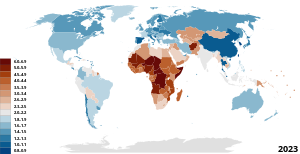
Map of countries by fertility charge per unit. India's fertility rate has greatly decreased in recent years and is now distinctly below the global rate.
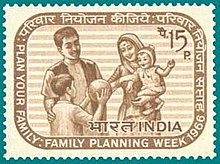
1966 family planning stamp from Bharat
Family planning in India is based on efforts largely sponsored past the Indian government. From 1965 to 2009, contraceptive usage has more than tripled (from xiii% of married women in 1970 to 48% in 2009) and the fertility rate has more than halved (from 5.seven in 1966 to 2.4 in 2012), but the national fertility rate in accented numbers remains loftier, causing business organisation for long-term population growth. Republic of india adds up to 1,000,000 people to its population every 20 days.[one] [2] [3] [4] [5] Extensive family planning has become a priority in an effort to curb the projected population of two billion past the terminate of the xx-commencement century.
In 2016, the total fertility rate of India was 2.30 births per woman[half dozen] and 15.6 1000000 abortions performed, with an abortion charge per unit of 47.0 abortions per yard women aged between 15 and 49 years.[7] With high abortions rates follows a high number of unintended pregnancies, with a rate of 70.one unintended pregnancies per 1000 women aged fifteen–49 years.[7] Overall, the abortions occurring in India brand upwards for one third of pregnancies and out of all pregnancies occurring, nearly half were not planned.[8] On the Demographic Transition Model, India falls in the third stage due to decreased birth rates and death rates.[9] In 2026, it is projected to exist in stage four once the Total Fertility Charge per unit reaches 2.1.[9]
Contraceptive usage [edit]

The Red Triangle indicates family planning products and services in Bharat

Women in India are not being fully educated on contraception usage and what they are putting in their bodies.[x] From 2005 to 2006 information was nerveless to indicate just 15.6% of women using contraception in India were informed of all their options and what those options actually exercise.[10] Contraceptive usage has been rise gradually in India. In 1970, 13% of married women used modernistic contraceptive methods, which rose to 35% by 1997 and 48% by 2009.[ii]
Awareness of contraception is nigh-universal amid married women in Bharat.[11] Still, the vast majority of married Indians (76% in a 2009 study) reported meaning issues in accessing a option of contraceptive methods.[iii] The above table clearly indicates more show that the availability of contraceptives is a problem for people in India. In 2009, 48.4% of married women were estimated to utilise a contraceptive method.[3] Virtually three-fourths of these were using female sterilization which is past far the most prevalent birth-control method in India.[iii] Condoms, at a mere 3%, were the next most prevalent method.[three] Meghalaya, at twenty%, had the lowest usage of contraception amidst all Indian states. Bihar and Uttar Pradesh were the other two states that reported usage below 30%.[iii] It is important to notation that sterilization is a common practice in India. Contraceptive practices in India are heavily skewed towards final methods like sterilization, which means that contraception is good primarily for birth limitation rather than nativity planning.[12] It is common to employ camps to enforce sterilization. This procedure tin exist done with or without consent.[13]
Comparative studies accept indicated that increased female person literacy is correlated strongly with a decline in fertility.[14] Studies have indicated that female literacy levels are an independent strong predictor of the use of contraception, even when women practice not otherwise have economic independence.[15] Female literacy levels in India may exist the master factor that help in population stabilisation, but they are improving relatively slowly: a 1990 study estimated that it would have until 2060 for India to accomplish universal literacy at the electric current rate of progress.[14]
In 2015, there was an average 58% of women who used contraceptives, with female sterilization still beingness the most preferred and favored amidst 91% of women.[16] Higher rates of sterilization are seen among women who hold less instruction than those with more educational activity. Those with higher education have lower rates due to the delay of getting married and childbirth.[xvi] 77% of the women who underwent sterilization had not used an alternative contraception prior to the procedure and nearly women were nether the age of 26, who seem to have many options available in regards to protection.[17] The preoccupation with birth limitation by Republic of india'south family planning programme has meant that it has non been able to successfully achieve immature married women who are in the process of building their family and enable them to meet their family planning intentions.[12]
Co-ordinate to Family planning 2020, in 2017 there were 136,569,000 women using modern method contraception which prevented: 39,170,000 unintended pregnancies, 11,966,000 unsafe abortions, and 42,000 maternal deaths due to family planning.[18] In 2012, India's modernistic contraception prevalence rate amidst all women was 39.2, in 2017 it was 39.57, and in 2020 is predicted to rise to 40.87.[18]
Family Planning Plan [edit]

A family unit planning stamp from 1989
The Ministry building of Health and Family Welfare is the authorities unit responsible for formulating and executing family planning in Bharat. An inverted Red Triangle is the symbol for family planning health and contraception services in India. In addition to the newly implemented government campaign, improved healthcare facilities, increased education for women, and higher participation among women in the workforce have helped lower fertility rates in many Indian cities. The objectives of the program are positioned towards achieving the goals stated in several policy documents.[nineteen] While India is improving in fertility rates, in that location are still areas of Bharat that maintain much higher fertility rates.[20] [21]
In 2017, Ministry of Health and Family Welfare launched Mission Pariwar Vikas, a central family planning initiative. The key strategic focus of this initiative is on improving access to contraceptives through delivering assured services, ensuring commodity security and accelerating admission to high quality family planning services. its overall goal is to reduce Republic of india's overall fertility charge per unit to 2.one by the year 2025.[22] Along with that two contraceptive pills, MPA (Medroxyprogesterone acetate) under Antara program and Chaya (earlier marketed as Saheli) will exist fabricated freely available to all government hospitals.[22]
Family unit planning programme benefits non only parents and children merely also to guild and nation, by being able to go on the number of new births under control allows for less population growth.[23] With less population growth this volition allow for more resources towards those already existing in the Indian population, with more resources comes longer life expectancy and better health.[23]
Fertility rate [edit]
India's current fertility charge per unit every bit of 2016, is two.3 births per woman. The fertility rate (average number of children born per woman during her lifetime) in India has been declining, though information technology has nonetheless not reached the average replacement rate nevertheless. The average replacement rate is two.1. (This rate is said to stabilize a population) Replacement rate tin be defined as the rate at which the population exactly replaces itself.[24] Factoring in infant mortality, the replacement charge per unit is approximately 2.ane in virtually industrialised nations and about 2.5 in developing nations (due to higher bloodshed). The fertility rates in India accept dropped chop-chop in rural areas, just are dropping at a stable rate in urban and populated areas.[25] Although this seems promising, ii-thirds of India's population resides in rural areas, adding to the decreased fertility rate.[25] Discounting immigration and population momentum furnishings, a nation that crosses beneath the replacement rate is on the path to population stabilisation and, eventually, population reduction. There have been several factors influencing recent trends in Indian fertility including, but not limited to: limitation of family planning ability, age at union/childbirth, and the infinite between children born to one woman.[19] Although India is dealing with major overpopulation issues, the fertility rate and the overall population is declining.[25]
Historical fertility trend [edit]
The fertility rate in India has been in long-term reject, and more than halved from 1960 to 2009. From 5.7 births per woman in 1966, it declined to 3.three births per woman by 1997 and two.seven births per woman in 2009.[4] [v] In 2005 the TFR, (total fertility rate), was listed every bit 2.9 births per women. Since this time, the country has recorded a steady decline in social club to reach the electric current rate (as of 2014) of two.iii births per adult female.[19]
State and country comparisons [edit]
Twenty Indian states have dipped below the ii.i replacement rate level and are no longer contributing to Indian population growth.[26] The full fertility rate of India stands at ii.2 as of 2017. Four Indian states take fertility rates to a higher place iii.v - Bihar, Uttar Pradesh, Meghalaya and Nagaland Of these, Bihar has a fertility rate of iv.0 births per woman, the highest of whatever Indian country. For detailed state figures and rankings, come across Indian states ranking by fertility rate.
In 2009, India had a lower estimated fertility rate than Pakistan and Bangladesh, simply a college fertility charge per unit than Communist china, Iran, Myanmar and Sri Lanka.[27]
Co-ordinate to Jin Rou New and colleagues inquiry and data[28] they were able to compile enough data to create the following tabular array.
| State | Prevalence of modern contraceptive employ in 2015 | Unmet demand for modernistic methods in 2015 | Demand satisfied with modern methods in 2015 | Change in prevalence of modern contraceptive utilise, 1990–2015 | Prevalence of modernistic contraceptive use in 2030 | Unmet need for mod methods in 2030 | Demand satisfied with modern methods in 2030 | Increase in per centum of users of modern methods required to meet 75% demand satisfied target compared with 2015 | Additional number of users of modern methods (millions) required to come across 75% demand satisfied target compared with 2015 |
|---|---|---|---|---|---|---|---|---|---|
| Andhra Pradesh | 69.8 (65.viii to 73.5) | v.5 (4.5 to 6.7) | 92.7 (90.ix to 94.2) | 25.1 (14.two to 36.2) | seventy.5 (51.four to 84.2) | 6.5 (2.vii to xiii.9) | 91.5 (79.4 to 96.9) | .. | .. |
| Arunachal Pradesh | 47.ii (36.4 to 58.0) | 23.three (16.iii to 31.ii) | 66.9 (55.3 to 77.iv) | 29.six (sixteen.9 to 42.3) | 55.4 (35.iv to 73.9) | xviii.9 (9.4 to 31.8) | 74.five (54.1 to 88.4) | 8.8 (–3.0 to 20.0) | 0.04 (0.02 to 0.06) |
| Assam | 40.nine (28.ix to 52.nine) | 35.6 (25.v to 47.7) | 53.v (38.3 to 67.0) | 21.7 (7.6 to 35.iv) | 48.five (26.0 to 69.1) | 28.half dozen (fourteen.1 to 50.0) | 62.9 (35.3 to 82.6) | 17.v (4.1 to 31.0) | ane.37 (0.72 to 2.01) |
| Bihar | 26.0 (22.five to 29.9) | 22.9 (20.5 to 25.6) | 53.1 (48.0 to 58.iii) | 6.3 (–1.7 to 13.iii) | 41.0 (24.4 to 60.0) | 21.2 (12.5 to 31.1) | 65.6 (46.7 to 82.3) | 21.2 (9.9 to 30.7) | 5.08 (3.04 to 6.78) |
| Chhattisgarh | 57.0 (46.iv to 67.one) | 16.7 (11.two to 23.vi) | 77.3 (67.two to 85.4) | 26.0 (–0.5 to 49.i) | 60.9 (40.8 to 77.nine) | 14.9 (vi.7 to 26.ix) | 80.two (61.6 to 91.nine) | .. | .. |
| Delhi | 58.0 (42.3 to 72.0) | 19.vi (11.3 to 31.7) | 74.7 (57.9 to 86.2) | six.4 (–12.1 to 23.vii) | 60.3 (38.seven to 78.0) | 18.0 (viii.1 to 33.8) | 77.0 (54.seven to 90.4) | 0.9 (–12.five to 16.0) | 0.54 (0.21 to 0.90) |
| Goa | 25.7 (22.3 to 29.6) | 20.ane (17.9 to 22.5) | 56.1 (51.0 to 61.ane) | –ten.0 (−twenty.0 to −0.5) | 38.8 (22.seven to 57.5) | 20.viii (12.half-dozen to 30.6) | 64.9 (45.8 to 81.2) | 19.five (8.1 to 29.5) | 0.06 (0.03 to 0.09) |
| Gujarat | 57.6 (41.nine to 71.4) | 16.vii ( 9.six to 27.3) | 77.5 (61.6 to 87.9) | 13.0 (–5.vi to thirty.5) | 60.5 (38.8 to 78.7) | 15.3 (six.8 to 29.6) | 79.7 (58.3 to 91.8) | .. | .. |
| Haryana | 58.four (54.0 to 62.five) | 13.8 (12.0 to 15.viii) | 80.9 (77.7 to 83.7) | 16.4 (5.9 to 26.7) | 60.9 (41.nine to 77.0) | xiii.8 (6.8 to 24.4) | 81.four (64.4 to 91.7) | .. | .. |
| Himachal Pradesh | 58.7 (47.8 to 68.8) | 15.v (ix.8 to 22.eight) | 79.1 (68.4 to 87.ii) | 6.eight (–seven.viii to 21.1) | 62.1 (41.9 to 78.9) | 13.8 (vi.1 to 25.5) | 81.viii (63.2 to 92.8) | .. | .. |
| Jammu and Kashmir | 47.6 (32.3 to 62.7) | 24.two (15.0 to 36.0) | 66.2 (49.0 to 80.3) | 10.4 (–7.7 to 28.2) | 53.4 (32.iii to 72.8) | xx.ix (10.0 to 36.9) | 71.7 (48.1 to 87.7) | 8.3 (–6.0 to 23.3) | 0.34 (0.eleven to 0.57) |
| Jharkhand | 45.9 (35.0 to 56.5) | 28.6 (twenty.7 to 37.seven) | 61.5 (49.0 to 72.6) | 28.iv (4.five to 46.v) | 54.i (32.8 to 73.1) | 22.8 (11.4 to 39.3) | 70.two (46.half dozen to 86.2) | 12.1 (0.0 to 23.4) | one.18 (0.55 to 1.75) |
| Karnataka | 54.1 (49.four to 58.eight) | 10.ix (nine.3 to 12.seven) | 83.2 (79.9 to 86.1) | 9.0 (–2.0 to 20.1) | 59.7 (40.2 to 76.7) | 11.4 (5.i to 20.4) | 84.0 (67.vi to 93.six) | .. | .. |
| Kerala | 54.vii (44.0 to 64.9) | 19.6 (thirteen.two to 27.3) | 73.6 (62.vi to 82.half dozen) | 3.0 (–11.0 to 17.0) | 58.1 (38.6 to 75.0) | 17.nine (8.eight to 31.2) | 76.4 (56.iv to 89.3) | ii.4 (–9.0 to 13.iv) | 0.55 (–0.18 to 1.25) |
| Madhya Pradesh | 52.4 (47.7 to 57.0) | fourteen.2 (12.4 to 16.3) | 78.half dozen (75.0 to 81.8) | sixteen.5 (–7.1 to 37.8) | 58.3 (39.iii to 75.0) | xiii.ix (6.viii to 23.7) | 80.seven (63.8 to 91.five) | .. | .. |
| Maharashtra | 63.5 (59.1 to 67.5) | 11.7 (10.1 to thirteen.5) | 84.4 (81.6 to 86.9) | xiii.0 (2.2 to 24.0) | 65.four (46.5 to 80.5) | xi.five (five.2 to 21.3) | 85.0 (69.4 to 93.8) | .. | .. |
| Manipur | 14.vii ( viii.9 to 22.iii) | twoscore.3 (xxx.9 to 50.iv) | 26.8 (16.7 to 38.five) | –seven.seven (–17.6 to 2.4) | 28.8 (13.ii to 48.viii) | 35.0 (22.2 to l.9) | 44.9 (22.5 to 67.2) | 33.8 (21.6 to 44.3) | 0.15 (0.eleven to 0.19) |
| Meghalaya | 21.1 (18.1 to 24.five) | 25.7 (23.one to 28.5) | 45.0 (40.ane to 50.0) | seven.6 (1.2 to thirteen.two) | 35.5 (nineteen.8 to 54.3) | 25.4 (sixteen.1 to 36.1) | 57.9 (38.4 to 76.2) | 25.3 (14.1 to 34.vii) | 0.thirteen (0.08 to 0.17) |
| Mizoram | threescore.i (48.nine to 70.3) | sixteen.4 (10.2 to 24.four) | 78.five (67.3 to 87.1) | viii.7 (–half-dozen.5 to 23.5) | 63.3 (43.1 to eighty.1) | 13.5 (5.5 to 25.4) | 82.four (63.7 to 93.six) | .. | .. |
| Nagaland | 37.0 (21.seven to 54.3) | 29.eight (19.8 to 41.iii) | 55.2 (36.seven to 72.5) | 25.0 (8.vii to 43.1) | 49.ane (27.vii to lxx.eight) | 23.vii (xi.7 to 39.4) | 67.2 (43.3 to 85.iv) | 17.8 (ii.4 to 32.2) | 0.06 (0.02 to 0.10) |
| Odisha | 48.3 (37.3 to 59.ii) | 26.6 (18.viii to 36.2) | 64.5 (51.4 to 75.v) | xv.seven (1.0 to 29.9) | 54.8 (34.0 to 73.0) | 21.4 (ten.7 to 37.8) | 71.9 (48.8 to 87.0) | 9.ii (–2.9 to 21.0) | ane.25 (0.39 to 2.04) |
| Punjab | sixty.3 (49.7 to 69.nine) | 15.ane (9.9 to 21.ix) | 79.ix (seventy.two to 87.3) | 12.0 (–two.0 to 25.ix) | 77.1 (64.ii to 87.0) | xiv.7 (6.9 to 26.8) | lxxx.7 (62.2 to 91.6) | .. | .. |
| Rajasthan | 62.3 (51.8 to 71.ii) | xvi.0 (10.8 to 23.0) | 79.5 (69.ix to 86.half-dozen) | 33.9 (20.1 to 46.4) | 65.5 (45.2 to 81.iii) | 13.9 (vi.3 to 26.v) | 82.4 (63.9 to 92.7) | .. | .. |
| Sikkim | 48.4 (43.4 to 53.3) | 22.3 (19.six to 25.three) | 68.5 (63.six to 72.eight) | 16.8 (–1.3 to 32.9) | 55.7 (36.3 to 73.3) | eighteen.7 (9.3 to thirty.5) | 74.vii (55.6 to 88.5) | 7.vii (–2.1 to 15.7) | 0.02 (0.01 to 0.03) |
| Tamil Nadu | 53.7 (48.9 to 58.five) | xi.4 ( 9.viii to 13.two) | 82.5 (79.0 to 85.4) | 10.8 (–0.two to 21.five) | 59.ii (39.ix to 75.ix) | 11.seven (5.4 to 20.6) | 83.v (67.0 to 93.2) | .. | .. |
| Tripura | 43.one (38.five to 47.eight) | 31.9 (27.0 to 37.8) | 57.five (50.8 to 63.five) | fourteen.3 (3.vii to 24.i) | 49.eight (29.0 to 68.6) | 26.3 (13.8 to 45.3) | 65.3 (xl.1 to 82.9) | 14.seven (4.9 to 23.3) | 0.17 (0.10 to 0.22) |
| Uttar Pradesh | 40.7 (29.8 to 52.0) | 35.0 (25.viii to 45.5) | 53.7 (xl.1 to 66.3) | 24.i (11.three to 36.9) | 51.vii (29.8 to 71.2) | 26.two (xiii.three to 44.nine) | 66.2 (41.v to 84.1) | 18.0 (5.five to xxx.2) | ix.18 (five.53 to 12.61) |
| Uttarakhand | 50.9 (46.iii to 55.three) | 19.nine (17.5 to 22.6) | 71.8 (67.7 to 75.six) | fifteen.2 (–8.3 to 36.vii) | 56.iv (37.7 to 73.seven) | 17.6 (9.0 to 29.iii) | 76.1 (57.iii to 89.0) | v.0 (–4.6 to xiii.ii) | 0.26 (0.09 to 0.39) |
| Westward Bengal | 57.five (52.9 to 61.9) | 21.7 (17.viii to 26.6) | 72.6 (66.8 to 77.four) | 21.seven (10.8 to 32.iii) | 59.vi (39.1 to 75.7) | xix.9 (10.0 to 37.iii) | 74.9 (52.1 to 88.1) | 2.6 (–6.5 to ten.four) | 2.10 (0.51 to 3.44) |
Family in Pronatalist India [edit]
Republic of india carries a pronatalist attitude towards fertility, with the large family unit structure creating an environment for new children to acquire and abound in Indian culture. In many parts of India, male children are favored over female children, yet efforts are being taken to change this attitude. Males are raised to be assertive and independent figures, while females are raised to put others before themselves, peculiarly their family. Families tend to encourage childbearing and expect to provide an environment of back up for any new members of the family, raising the children based on Indian family unit practices and beliefs. Children are not encouraged to exist independent or help the family from an early historic period, rather the family expects to support and provide for the kid until they reach boyhood.[29]
Two-Child Policy [edit]
Multiple Indian states have adopted a limited two-child policy. The policies are implemented by prohibiting persons with more than 2 children from serving in government.[30] The most contempo policy to exist implemented was past Assam in 2017.[31] Some states have repealed policies; Chhattisgarh introduced a policy in 2001[32] and repealed it in 2005.[33]
A criticism of these policies is that it decreases the number of women in regime positions, and encourages sex activity-selective abortions.[34]
As of 2014, there were xi Indian states that implemented the two-child policy, in hopes to reduce the number of children per family.[35] The policy was geared mainly towards politicians, future and aspiring, to limit their number of children to 2 or less.[35] Those who held politicians have stricter policies in hopes that they will set an example for the community, if one were to exceed the limit of two children while employed, they would be terminated from the task.[35] Not-politicians may also receive consequences to exceed the ii child limit, the government begins to withhold health care, government rights, face jail and, fees.[35]
Modern Initiatives in Reproductive Wellness [edit]
Progress on reproductive health and family unit planning has been limited.[ citation needed ] As of 2016, Republic of india'due south infant bloodshed rate is 34.six per 1000 livebirths,[36] and as of 2015, maternal bloodshed sits at 174 per 100,000 livebirths.[37] Leading causes of maternal mortality include hemorrhage, sepsis, complications of abortion, and hypertensive disorders, and infection, premature birth, birth asphyxia, pneumonia, and diarrhea for infants.[38] In 2005, the Government of Bharat established the National Rural Health Mission (NRHM) in try to address some of these issues amidst others.[38] The objective of the NRHM includes the provision of effective healthcare to rural areas, particularly to poor and vulnerable populations.[39] Through the NRHM, special provisions take been made to address concerns for reproductive health, especially for adolescents who are more likely to participate in risky sexual behaviors and less likely to visit health facilities than adults.[40] Ultimately, the NRHM aims to push Bharat towards the Millennium Development Goal targets for reproductive wellness.[38]
History of Family Planning Programmes [edit]
Raghunath Dhondo Karve published a Marāthi-linguistic communication magazine Samaj Swasthya (समाज स्वास्थ्य) starting from July 1927 until 1953. In information technology, he continually discussed issues of society's well-being involving population control through use of contraceptives. He explained the employ of contraception would help prevent unwanted pregnancies and induced abortions. Karve proposed that the Indian Government should have upwardly a population control programme, merely was met with opposition. Mahatma Gandhi was the main opponent of birth control. His opposition was the issue of his belief that self-control is the best contraceptive. However, Periyar'south views were strikingly different from that of Gandhi. He saw birth control equally a means for women to control their own lives.[41]
In 1952, Bharat became the starting time country in the developing world to create a state-sponsored family planning programme, the National Family Planning Program.[42] The plan's main objectives were to lower fertility rates and slow population growth as a means to propel economic evolution.[43] The program was based on v guiding principles:
- "The customs must be prepared to feel the need for the services in order that, when provided, these may exist accepted
- Parents lonely must make up one's mind the number of children they want and their obligations towards them
- People should be approached through the media they respect and their recognized and trusted leaders and without offending their religious and moral values and susceptibilities
- Services should be made bachelor to the people as near to their doorsteps equally possible
- Services accept greater relevance and effectiveness if made an integral role of medical and public health services and especially of maternal and kid wellness programs"[44]
The program was tied to a serial of five year plans aimed at economical growth and restructuring which were carried out over 28 years, from 1952 to 1979.[43] Over the class of this period, preferred nascency control methods shifted from the rhythm method somewhen to a focus on sterilization and IUDs.[43]
Since the beginning, India's family planning program was marred by a "vertical approach" rather than working on additional factors. These factors affecting population growth include poverty, education, public wellness care. Owing to the foreign aid flowing in for the family unit planning programs, there has always been a foreign intervention in designing the family planning programs in India without assessing the actual socio-economic weather condition of the state. In the early on 1970s, Indira Gandhi, Prime Government minister of Republic of india, had implemented a forced sterilisation programme, but failed. Officially, men with two children or more than had to submit to sterilisation, but many unmarried young men, political opponents and ignorant, poor men were as well believed to have been sterilised. This program is all the same remembered and criticised in Bharat, and is blamed for creating a public disfavor to family unit planning, which hampered Government programs for decades.[45] Afterwards emergency the focus of family planning program shifted to women as sterilising men proved to be politically expensive.[21]
Over the form of the program, family planning in India resulted in a 19.9% decrease in birth rate where it has since stagnated at 35 births per k persons.[43] Past 1996, the program had been estimated to have averted 16.8 crore births.[46] This is due in part to regime intervention which established many clinics too every bit the enforcement of fines for those who avoided family unit planning. Additionally, in that location was high variance between regions in the use of family unit planning.[47] All the same, maternal and infant morbidity and mortality rates remain loftier along with the number of unsafe abortions, and lilliputian is known about the prevalence of sexually transmitted diseases.[48]
See also [edit]
- Listing of states and union territories of India past fertility rate
- Total fertility rate
- One-child policy in China
- Birth command
- Human being population planning
References [edit]
- ^ Rabindra Nath Pati (2003). Socio-cultural dimensions of reproductive kid health. APH Publishing. p. 51. ISBN978-81-7648-510-4.
- ^ a b Marian Rengel (2000), Encyclopedia of birth control, Greenwood Publishing Grouping, ISBN978-1-57356-255-3, archived from the original on 7 Oct 2015, retrieved 1 February 2016,
... In 1997, 36% of married women used modern contraceptives; in 1970, only thirteen% of married women had ...
- ^ a b c d e f Republic of india and Family Planning: An Overview (PDF), Department of Family unit and Community Wellness, World Wellness Organization, archived from the original (PDF) on 21 December 2009, retrieved 2009-11-25
- ^ a b Thou.N. Ramu (2006), Brothers and sisters in India: a study of urban adult siblings, Academy of Toronto Press, ISBN978-0-8020-9077-5, archived from the original on 3 May 2016, retrieved 1 February 2016
- ^ a b Arjun Adlakha (April 1997), Population Trends: Bharat (PDF), U.S. Department of Commerce, Economics and Statistics Administration, Bureau of the Demography, archived from the original (PDF) on 10 October 2013, retrieved 5 Dec 2009
- ^ "ESTIMATES OF FERTILITY INDICATORS" (PDF). data.worldbank.org. Archived (PDF) from the original on 19 Baronial 2020. Retrieved xix Jan 2020.
- ^ a b Singh, Susheela; Shekhar, Chander; Acharya, Rajib; Moore, Ann M; Stillman, Melissa; Pradhan, Manas R; Frost, Jennifer J; Sahoo, Harihar; Alagarajan, Manoj (1 January 2018). "The incidence of ballgame and unintended pregnancy in India, 2015". The Lancet Global Health. 6 (i): e111–e120. doi:10.1016/S2214-109X(17)30453-9. ISSN 2214-109X. PMC5953198. PMID 29241602.
- ^ Singh, Susheela; Shekhar, Chander; Acharya, Rajib; Moore, Ann M; Stillman, Melissa; Pradhan, Manas R; Frost, Jennifer J; Sahoo, Harihar; Alagarajan, Manoj (i January 2018). "The incidence of abortion and unintended pregnancy in India, 2015". The Lancet Global Health. half-dozen (1): e111–e120. doi:x.1016/S2214-109X(17)30453-9. ISSN 2214-109X. PMC5953198. PMID 29241602.
- ^ a b "Trends in Demographic Transition in Bharat - General Cognition Today". www.gktoday.in. Archived from the original on 12 Apr 2018. Retrieved 12 Apr 2018.
- ^ a b Jain, Anrudh (8 Nov 2016). "Information about methods received by contraceptive users in India". Population Quango. Archived from the original on half-dozen April 2017. Retrieved v Apr 2017.
- ^ B.M. Ramesh; S.C. Gulati; R.D. Retherford, "Contraceptive employ in India, 1992-93" (PDF), National Family unit Wellness Survey Subject Reports, Number ii, October 1996, archived (PDF) from the original on 5 August 2016, retrieved 25 November 2009
- ^ a b Chaurasia, Aalok Ranjan (2014). "Contraceptive Employ in India: A Data Mining Approach". International Periodical of Population Enquiry. 2014: 1–11. doi:10.1155/2014/821436.
- ^ Library, Auraria. "Skyline: Auraria Library Itemize". 0-go.galegroup.com.skyline.ucdenver.edu . Retrieved 29 March 2017. [ permanent expressionless link ]
- ^ a b How Female Literacy Affects Fertility: The Case of India (PDF), Population Plant, East-West Center, Dec 1990, archived from the original (PDF) on 25 December 2010, retrieved 25 November 2009
- ^ A. Dharmalingam; Due south. Philip Morgan (1996), "Women'south piece of work, autonomy, and birth control: bear witness from two south India villages", Population Studies, 50 (2): 187–201, doi:10.1080/0032472031000149296, JSTOR 2174910
- ^ a b Thulaseedharan, Jissa Vinoda (5 January 2018). "Contraceptive use and preferences of young married women in Kerala, Republic of india". Open Access Journal of Contraception. 9: one–x. doi:ten.2147/OAJC.S152178. PMC5804019. PMID 29440936. Archived from the original on 12 April 2018.
- ^ Pachauri, Saroj (November 2014). "Priority strategies for Bharat's family unit planning programme". The Indian Journal of Medical Research. 140 (Suppl 1): S137–S146. PMC4345745. PMID 25673535.
- ^ a b "Family Planning 2020". www.familyplanning2020.org. Archived from the original on 13 Apr 2018. Retrieved 5 April 2018.
- ^ a b c "National Health Mission". Archived from the original on xi Jan 2013.
- ^ New, Jin Rou; Cahill, Niamh; Stover, John; Gupta, Yogender Pal; Alkema, Leontine (2017). "Serials Solutions 360 Link". The Lancet Global Health. v (3): e350–e358. doi:10.1016/S2214-109X(17)30033-5. PMID 28193400.
- ^ a b Rao, Mohan(2004) from population command to reproductive health, Sage Publications, ISBN 0-7619-3269-0
- ^ a b "Health Ministry launches ii new contraceptives". pib.nic.in. Archived from the original on 6 September 2017. Retrieved 6 September 2017.
- ^ a b Jain, Anrudh K. (December 2011). "Measuring the consequence of fertility pass up on the maternal bloodshed ratio". Studies in Family unit Planning. 42 (4): 247–260. doi:x.1111/j.1728-4465.2011.00288.x. ISSN 0039-3665. PMID 22292244.
- ^ Searchinger, Tim; Hanson, Craig; Waite, Richard; Lipinski, Brian; Leeson, George (8 July 2013). "Achieving Replacement Level Fertility". Archived from the original on 6 March 2017. Retrieved 31 March 2017.
- ^ a b c "India's Growth Held Back by Overpopulation". PBS NewsHour. Archived from the original on 28 Baronial 2017. Retrieved 28 March 2017.
- ^ "3 states agree the key". The Indian Express. fifteen July 2016. Archived from the original on 26 May 2017. Retrieved 1 June 2017.
- ^ CIA, Land Comparison: Total Fertility Rate, The World Factbook, Central Intelligence Agency, archived from the original on 28 October 2009, retrieved 24 November 2009
- ^ a b New, Jin Rou; Cahill, Niamh; Stover, John; Gupta, Yogender Pal; Alkema, Leontine (1 March 2017). "Levels and trends in contraceptive prevalence, unmet demand, and demand for family planning for 29 states and spousal relationship territories in India: a modelling study using the Family unit Planning Estimation Tool". The Lancet Global Health. 5 (3): e350–e358. doi:ten.1016/s2214-109x(17)30033-5. ISSN 2214-109X. PMID 28193400.
- ^ "India - Family Life And Family unit Values". family.jrank.org. Archived from the original on 30 March 2017. Retrieved 29 March 2017.
- ^ "Indian State Proposes A Two-Child Limit for Regime Employees - PRI". half-dozen January 2017. Archived from the original on 12 February 2018. Retrieved 7 Feb 2018.
- ^ "Assam authorities effects 2-kid policy - Times of India". Archived from the original on 5 June 2018. Retrieved seven Feb 2018.
- ^ Waldman, Amy (7 November 2003). "States in Bharat Take New Steps To Limit Births". The New York Times. Archived from the original on 12 Feb 2018. Retrieved 7 Feb 2018.
- ^ s, Rukmini (7 September 2014). "2-kid norm for local bodies hurts sex ratio". The Hindu. Archived from the original on 12 February 2018. Retrieved 7 February 2018.
- ^ Buch, Nirmala (June 2005). "Law of Two-Kid Norm in Panchayats: Implications, Consequences and Experiences". Economic and Political Weekly. 40 (24): 2421–2429. JSTOR 4416748.
- ^ a b c d Page, Vanessa (14 May 2015). "India'due south Two-Child Policy". Investopedia. Archived from the original on 12 April 2018. Retrieved 12 April 2018.
- ^ "Mortality rate, infant (per 1,000 live births) | Data". data.worldbank.org. Archived from the original on 4 May 2018. Retrieved four May 2018.
- ^ "Maternal mortality ratio (modeled estimate, per 100,000 live births) | Information". data.worldbank.org. Archived from the original on 27 January 2018. Retrieved 4 May 2018.
- ^ a b c Paul, Five. K.; Sachdev, H. S.; Mavalankar, D.; Ramachandran, P.; Sankar, G. J.; Bhandari, N.; Sreenivas, 5.; Sundararaman, T.; Govil, D.; Osrin, D.; Kirkwood, B. (22 January 2011). "Reproductive health, and child wellness and diet in India: coming together the challenge". The Lancet. 377 (9762): 332–349. doi:10.1016/S0140-6736(10)61492-4. ISSN 0140-6736. PMC3341742. PMID 21227494.
- ^ Hota, Prasanna (1 March 2006). "National rural health mission". The Indian Periodical of Pediatrics. 73 (three): 193–195. doi:10.1007/BF02825478. ISSN 0019-5456. PMID 16567909. S2CID 11290228.
- ^ Mehta, Bharti; Kaur, Amandeep; Kumar, Vijay; Chawla, Sumit; Khatri, Sneh; Malik, Manisha (27 Dec 2015). "Adolescent Reproductive and Sexual Health in Bharat: The Demand to Focus". Periodical of Young Medical Researchers. 1 (1). Archived from the original on 4 May 2018. Retrieved iv May 2018.
- ^ Rao, Mohan(2004) from population control to reproductive health, Sage publications, ISBN 0-7619-3269-0
- ^ Visaria, Leela; Jejeebhoy, Shireen; Merrick, Tom (1999). "From Family Planning to Reproductive Health: Challenges Facing India". International Family Planning Perspectives. 25: S44–S49. doi:x.2307/2991871. JSTOR 2991871.
- ^ a b c d Ledbetter, Rosanna (1984). "Thirty Years of Family Planning in India". Asian Survey. 24 (7): 736–758. doi:x.2307/2644186. JSTOR 2644186. PMID 11616645.
- ^ Banerji, D. (1974). "Family Planning in India: The Outlook for 2000 AD". Economical and Political Weekly. 9 (48): 1984–1989. JSTOR 4364205.
- ^ "Manas: History and Politics, Indira Gandhi". Sscnet.ucla.edu. Archived from the original on 29 July 2016. Retrieved 3 August 2012.
- ^ B.N. Saxena (1996), "Reproductive Health in Bharat", Advances in Contraception, 12 (4): 265–270, doi:10.1007/BF01849328, PMID 9048992, S2CID 26416664,
... The National Family unit Welfare Programme, established in Republic of india during the tardily 1950s, has averted about 168 million births since its inception ...
- ^ Mo, H. F. (September 1986). "[Family planning in India]". Ren Kou Yan Jiu = Renkou Yanjiu (five): 51–54. ISSN 1000-6087. PMID 12315380.
- ^ Saxena, B. North. (1 December 1996). "Reproductive wellness in India". Advances in Contraception. 12 (4): 265–270. doi:10.1007/BF01849328. ISSN 0267-4874. PMID 9048992. S2CID 26416664.
Further reading [edit]
- Mandani, Mahmood (1972). The Myth of Population Command: Family, Caste, and Form in an Indian Hamlet, in series, Mod Reader. First Modernistic Reader Pbk. ed. New York: Monthly Review Press, 1973, cop. 1972. 173 p. SBN 85345-284-ix
Source: https://en.wikipedia.org/wiki/Family_planning_in_India

Post a Comment for "Hindu Community Leaders on Family Planning in India"