First Black Man to Take Over a Family Business
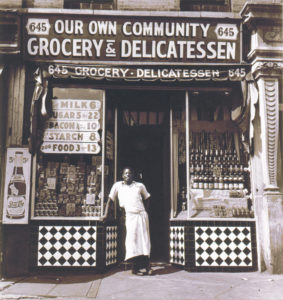
At the new National Museum of African American History and Culture in Washington, D.C., a hallway of glass display cases features more a century of black entrepreneurial triumphs. In one is a World State of war Two–era mini parachute manufactured by the black-owned Pacific Parachute Company, abode to 1 of the nation'due south kickoff racially integrated product plants. Another displays a giant fourth dimension clock from the R. H. Boyd Publishing Company, among the earliest firms to print materials for blackness churches and schools. Although pocket-size, the showroom recalls a now largely forgotten legacy: by serving their communities when others wouldn't, blackness-owned independent businesses provided avenues of upward mobility for generations of black Americans and supplied critical leadership and fiscal back up for the civil rights movement.
This tradition continues today. Last June, Blackness Enterprise magazine marked the forty-quaternary anniversary of the Be 100s, the mag's annual ranking of the nation'due south top 100 blackness-owned businesses. At the superlative of the list stood Globe Wide Applied science, which, since its founding in 1990, has grown into a global firm with more than than $7 billion in revenue and iii,000 employees. Then came companies like Radio 1, whose fifty-5 radio stations fan out among sixteen national markets. The combined revenues of the Be 100s, which also includes Oprah Winfrey'due south Harpo Productions, now totals more $24 billion, a ninefold increase since 1973, adjusting for aggrandizement.
A closer look at the numbers, nonetheless, reveals that these pioneering companies are the exception to a far more alarming tendency. The last xxx years also have brought the wholesale collapse of black-owned independent businesses and financial institutions that once anchored blackness communities across the country. In 1985, sixty black-endemic banks were providing fiscal services to their communities; today, just twenty-three remain. In xi states that headquartered black-endemic banks in 1994, non a unmarried one is however in business. Of the 50 black-endemic insurance companies that operated during the 1980s, today just two remain.
Over the same catamenia, tens of thousands of black-endemic retail establishments and local service companies likewise have disappeared, having gone out of business or been acquired past larger companies. Reflecting these developments, working-age black Americans have become far less probable to be their own boss than in the 1990s. The per capita number of black employers, for case, declined by some 12 pct but betwixt 1997 and 2014.
What's behind these trends, and what's the implication for American society equally a whole? To exist sure, at least some of this entrepreneurial reject reflects positive economic developments. A slowly rising share of black Americans now concur white-collar salaried jobs and take more options for employment beyond running their own businesses. The motion of millions of black families to integrated suburbs over the last xl years too is a welcome trend, fifty-fifty if one effect has been to weaken the viability of the many black-endemic independent businesses left backside in historically black neighborhoods.
But the decline in entrepreneurship and business buying among black Americans also is cause for concern. Ane reason is that information technology largely reflects non the opening of new avenues of upward mobility, but rather the foreclosing of opportunity. Rates of business ownership and entrepreneurship are falling among black citizens for much the same reason they are declining among whites and Latinos. Every bit large retailers and financial institutions comprise an ever-bigger slice of the national economy, the possibility of starting and maintaining an independent business has dropped. The Washington Monthly has addressed the part of market place concentration in suppressing opportunity and in displacing local economies in depth (come across, for example, "The Slow-Motion Collapse of American Entrepreneurship," July/August 2012, and "Blossom and Bust," Nov/December 2015). Other studies, including a written report published last year by President Obama'due south Council of Economic Advisors, have substantiated these developments.
The function of marketplace concentration in depressing black-owned businesses is also troubling because of the disquisitional function that such enterprises have played in organizing and financing the struggle for civil rights in America. In the 1950s and '60s, black Americans employed past whites, including professionals like teachers, often faced dismissal if they joined the civil rights movement, whereas those who owned their own independent business organization had much greater liberty to resist. This is a largely forgotten history, just i that is gaining new urgency for all Americans in the age of Donald Trump. It shows the crucial fashion in which advancing and protecting bones ceremonious rights tin can depend not only on moral and concrete courage, but also on possessing the economic independence to stand up to full-bodied power.
The decline of blackness-owned independent businesses traces to many causes, but a major one that has been little noted was the decline in the enforcement of anti-monopoly and fair trade laws commencement in the late 1970s. Under both Autonomous and Republican administrations, a few firms that in previous decades would never have been immune to merge or grow and so big came to dominate almost every sector of the economy.
This change has hurt all independent businesses, just the effects have disproportionately hit black business organization owners. Marcellus Andrews, Bucknell University professor of economics, says that pulling back on anti-monopoly enforcement was a "catastrophic intellectual and political policy mistake," and that for the blackness community, the "presumed toll advantages of concentration often do not translate into better economical opportunities."
A case in point is the decline of blackness-owned financial institutions, including banks and insurance companies. "Mainstream insurers went after black insurance companies for their top personnel to sell their products," says Wichita State professor Robert Weems Jr. When MetLife bought United Common Life Insurance Visitor in 1993, this was the end of the 60-three-twelvemonth beingness of the concluding black-owned insurance company in the Northeast. Black Enterprise called the 1990s "a virtual bloodbath" for the black insurance manufacture, noting that from 1989 to 1999, the number of black-owned insurers declined past 68 percent.
Parks Sausage—which many readers of a certain age may remember for its jingle "More than Parks Sausages, Mom, delight"—too serves equally an example of how market concentration led to the pass up of black-owned contained businesses. Founded in 1951 by Henry Parks Jr., the Baltimore-based visitor grew into a multimillion-dollar performance, selling pork products from New England to Virginia. In 1969, Parks took the company public, making the 200-employee firm the first black-owned business organization on the New York Stock Exchange. Nevertheless past the 1990s, after a turbulent series of ownership changes, the company had fallen into bankruptcy. In 1996, two black Americans, the one-time football stars Franco Harris and Lydell Mitchell, attempted to revive the company, but faced an increasingly consolidated meatpacking manufacture in which the four largest meatpackers controlled 78 percent of the market. Every bit Harris put information technology, earlier selling out, "it'southward been hard to go distribution."
Much the aforementioned story occurs with blackness-owned grocers. In 1969, J. Bruce Llewellyn grew 10 Bronx supermarkets into the nation's largest minority-owned retail business organization. By the 1990s, nevertheless, a retreat from antitrust enforcement and other off-white trade laws permitted a few giant corporations like Walmart to engage in anticompetitive behaviors that in previous decades would have resulted in civil and criminal prosecution. These included undermining the pricing power of suppliers and loss leading, or the exercise of selling below cost in order to drive competitors out of business. In 1999, Llewellyn sold his last remaining stores to the Dayton-Hudson Corporation, now known equally the Target Corporation.
In 1986, a tiptop executive at Revlon made a prediction about the futurity of the beauty and hair care industry. "In the next couple of years," he told Newsweek, "the black-owned businesses volition disappear. They'll all be sold to white companies." The prediction proved authentic. In 1993, IVAX Corp. purchased Johnson Products Co., the xxx-nine-year-old maker of Ultra Sheen, beginning a decade-long series of acquisitions that wiped out remaining black ownership in the hair care industry. One consequence was fewer new hair care products for black customers. Funds once channeled into research and development, University at Buffalo professor Robert Marking Silverman explains, now were accrued as profits by the larger firms.
Much the same has happened to black-owned firms in the entertainment, communications, and publishing sectors. In response to the merger wave, the founder of Black Entertainment Television set, Robert Johnson, told an audience at an investment conference in 1997, "You cannot become big anymore by existence 100 percentage blackness-endemic anything." Four years later, Viacom bought out BET for $2.34 billion. In 2005, Time Warner caused Essence Communications Partners, the publisher of the then-leading blackness women's magazine, Essence.
Meanwhile, "small enterprises," writes the business scholar John Sibley Butler, "could not compete with the expansion of larger retail chains, shopping malls, and franchises which developed." Black-owned funeral homes are a prime example. During the civil rights era, writes author Suzanne Smith in her book To Serve the Living, "funeral directors were usually among the few black individuals in any town or city who were economically contained and non beholden to the local white power construction." Even so, today, blackness-endemic independent funeral homes are an imperiled institution, every bit national chains similar Service Corporation International muscle out more than and more than businesses. Charlotte Clark, a black funeral home possessor in Roanoke, Alabama, explains that these companies "buy local folks' funeral parlors but get out up the signs and play it off similar at that place's been no change, simply phone call the shots from elsewhere." The National Funeral Directors and Morticians Association, which represents black funeral directors, has seen its membership subtract by 40 percent since 1997.
Reflecting on the by iii decades, Bob Dickerson, CEO of the Birmingham Business organization Resource Middle in Alabama, says, "Had our institutions and businesses been maintained, had that coin been plowed back into our communities, it could have meant a world of difference."
The function of market concentration in driving down the number of black-owned independent businesses becomes all the more than apropos when one considers some mostly forgotten history. In principles, people, and tactics, the fight for black civil rights, going back to earlier the Civil War, was oft securely intertwined and aligned with America'due south anti-monopoly traditions.
An early on case is the Free Soil Political party. Emerging in the 1840s, its members opposed slavery on moral grounds. They besides opposed all forms of monopoly power every bit a threat to liberty, including its nearly terrible manifestation: the monopoly of slave owners over slaves. Marching nether the imprint of "Complimentary Soil, Free Speech, Complimentary Labor, and Gratis Men," the movement focused on granting equal citizenship to all Americans, in large function by promoting the then-radical idea of giving blackness freedmen and slaves the correct to own the state on which they labored.

Complimentary Soilers proposed breaking up land monopolies and dividing western lands into 50-to-100-acre homesteads that would grant white and black families independence. As the antebellum history scholar Jonathan Earle explains, "Opponents of aristocracy, country monopoly, and slavery saw yeoman farming and inalienable landownership as the truthful opposites of servitude." It was therefore no surprise when Helen Douglass, the wife of the Free Soiler and abolitionist Frederick Douglass, wrote that his opposition against any type of compulsion "non merely fabricated him a foe to American slavery, but too to all forms of monopoly."
Afterward the Ceremonious State of war, passage of the Fourteenth Subpoena, which outlawed racially discriminatory laws like the Black Codes, depended in no small part on white supporters who saw it as a means of prohibiting all grants of monopoly or class privilege. An 1866 article in the Boston Daily Advertiser said it "[threw] the aforementioned shield over the black homo as over the white, over the humble as over the powerful." In fact, one of the earliest applications of the police was by a group of independent Louisiana butchers who argued that a state-sanctioned twenty-five-year shambles monopoly violated the Fourteenth Amendment.
During Reconstruction, the relationship betwixt blackness political enfranchisement and economic independence gained strength. Abolitionists in Congress passed the Southern Homestead Act, which promised to replace the monopoly of slavery with the creation of a black yeomanry secured with grants of free land. Like General William Tecumseh Sherman's Special Field Lodge No. 15, with its hope of "40 acres of tillable ground" to newly freed slaves, it fell victim to white backlash and sectional compromise, and was rescinded. Nevertheless, by the 1890s, blackness Americans who owned or aspired to own their ain country joined with independent white farmers in the multiracial Populist Political party, in states including Georgia and Texas.
The natural alliance between supporters of black civil rights and opponents of monopoly, though strained by race-baiting demagogues, especially during the darkest days of Jim Crow, would endure. Every bit a 1913 editorial by the National Clan for the Advancement of Colored People (NAACP) put it, the Emancipation Declaration and the legacy of the Free Soil movement "gave blackness men not just physical freedom, just it attempted to give them political freedom and economic freedom and social freedom. It knew then, as it knows now, that no people tin can be free unless they have the right to vote, the correct to land and capital, and the right to cull their friends."
To exist certain, many blackness leaders during this era recognized that economic independence was a necessary just non sufficient condition for securing total rights as citizens. Unlike their white counterparts, independent black business owners were vulnerable to the brutality of lynching, to voter suppression at the polls, and to the plundering of black business districts past white supremacists. Withal many black leaders nonetheless saw that the fight for racial justice besides required expanded economic independence, which in plow depended on containing market concentration.
In the early twentieth century, groups like the National Negro Business League, for instance, supported anti–chain store legislation as a fashion to preserve blackness Americans' economical cocky-sufficiency and liberty. As an editorial in the black newspaper New Journal and Guide bemoaned, "Chain stores are constantly draining every dollar, every week, from all of our Southern communities . . . never putting any of it back and so that the communities can use information technology again." Indeed, many black leaders supported these laws, even though the Ku Klux Klan and many racist white populists also championed them for their own reasons.
In 1928, W. E. B. Du Bois validated the black community's embrace of anti-monopolism when he wrote, "To ask the individual colored man . . . to sell meat, shoes, candy, books, cigars, clothes or fruit in competition with the chain store, is to enquire him to commit ho-hum but almost inevitable economic suicide." In 1932, the Associated Negro Printing and the National Negro Concern League, with the cooperation of the U.S. Department of Commerce, printed a newspaper column called "Business and Manufacture." 1 article in the serial noted that "an embarrassing problem confronts the 70,000 or more than Negro-owned individual enterprises in the U.S. today[:] . . . Big Business, which so perceptibly handicaps the small industrial business units in which category Negro enterprise unquestionably belongs."
Coming into the New Deal era, the federal government adopted many policies that enormously benefited whites but did little or cypher to help black Americans. The Federal Housing Authority engaged in redlining, the destructive practice of refusing to issue mortgages in predominately blackness neighborhoods. The Wagner Human activity left black workers withal unable to join unions. Black agricultural and domestic laborers couldn't reap the benefits of Social Security. "Roosevelt'south New Bargain," Ta-Nehisi Coates has argued, "rested on the foundation of Jim Crow." But the expansion of anti-monopoly laws that also occurred during this menstruation provided one of import exception to this blueprint.
These measures included stepped-up antitrust enforcement, along with new fair trade laws, like the Robinson-Patman Act of 1936 and the Miller-Tydings Human action of 1937, that prevented ascendant firms from exploiting their market power. Combined with anti–chain shop measures passed in twenty-seven states, the new legal and regulatory constraints on market concentration benefited contained enterprise, including black-endemic contained businesses. Between 1935 to 1939 the number of black-owned retail stores increased by 31 percent and the number of black employees hired past black-owned retail stores grew past fourteen.5 pct.
Into the 1940s, black leaders battled segregation while continuing to advocate for anti-monopoly laws. In August 1941, the student organization Negro Youth published a list of demands from the National Defense Programme, including "that the Attorney General investigate and prosecute all violations of the Sherman Antitrust laws." In response to a 1947 New York fair merchandise constabulary that prohibited loss leading, a coalition of black wholesale grocers declared that the law "will afford additional protection to the minor man of affairs, exist he Negro or white."
Independent business owners too played a fundamental function in financing ceremonious rights protests, particularly during their peak in the 1950s and '60s. In Tallahassee, black grocery shop possessor Daniel Speed bankrolled a bus cold-shoulder like to that in Montgomery, and his shop served as a meeting ground for blackness leaders. In Biloxi, Gilbert R. Stonemason, owner of Mod Drug Store, led a "wade-in" confronting the whites-simply section of a federally funded Gulf Coast beach. In his autobiography, Mason wrote, "Pharmacists represented an economically contained class of black businessmen who might have been thought hard for the white establishment to command. In many cases, the black-owned pharmacy was itself a nexus in black communities."
Funeral home owners emerged as another powerful bloc of civil rights activists. In 1956, funeral dwelling house possessor William Shortridge cofounded the Alabama Christian Movement for Human Rights, a group that sought to end employment discrimination and abolish segregation in public accommodations. A. G. Gaston, who built his business empire as the owner of the Smith and Gaston Funeral Dwelling house, threatened to transfer his accounts from a white-owned bank unless it removed a "Whites Just" sign from a water fountain. In 1963, he lent Martin Luther King Jr. a room at his Gaston Cabin. Soon known as the "War Room," it was in that location that Male monarch decided to submit himself to abort in Birmingham, a galvanizing moment in the civil rights movement.
King himself connected part of the ceremonious rights movement with the struggle against market concentration. While giving a talk in 1961 to students at the Southern Baptist Theological Seminary in Louisville, King drew parallels between the Sherman Antitrust Human activity and discrimination in public accommodations, noting, "This is what is said in the Sherman [Antitrust] Deed, that if a business is in the public market it cannot deny admission . . . [a]nd I retrieve the same thing applies here . . . that a man should not have the correct to say on the basis of color or religion, one cannot utilise a dejeuner counter that is open up to anybody else in another racial grouping but not to these particular people; he has an obligation to the public."
In this era, support for the civil rights movement and opposition to monopoly were political stands often advocated past the aforementioned person. For example, Justice Felix Frankfurter, who fabricated anti-monopoly policy one of the causes of his life, served on the NAACP'south National Legal Committee while also being the outset member of the Supreme Court to hire a black law clerk. New York Representative Emanuel Celler sponsored the Celler-Kefauver Human action of 1950, a major anti-monopoly law, and likewise introduced the Civil Rights Deed in the Firm. Sargent Shriver, the architect of Lyndon Johnson's State of war on Poverty programme, said at a dinner reception describing his vision for anti-discrimination laws and programs like Head Start, VISTA, and Job Corps, "The twenty-four hours may well come when Congress enacts a new Sherman Act for the social field—an antitrust constabulary to ensure that . . . monopoly power is not used to expand and perpetuate itself."
Attorney General Robert F. Kennedy similarly drew a link between civil rights and anti-monopoly policy. "The principles of free enterprise which the antitrust laws are designed to protect and vindicate," he said in 1961, "are economic ideals that underlie the whole structure of a free society." Ii years afterwards, King, in his sermon "On Being a Good Neighbor," echoed Kennedy'southward vision when he said, "Our unswerving devotion to monopoly commercialism makes united states concerned almost the economic security of the captains of manufacture, and non the laboring men whose sweat and skills keep the wheels of manufacture rolling."
Black Americans employed by whites, including professionals like teachers, often faced dismissal if they joined the ceremonious rights movement, whereas those who owned their own independent business had much greater freedom to resist.
A seminal moment in the history of the civil rights movement came on a bloody Sunday in 1965 when Alabama state troopers attacked John Lewis and hundreds of others marching across the Edmund Pettus Bridge in back up of voting rights. Here, also, the of import link between black-owned independent businesses and civil rights was operating behind the scenes. Civil rights leader Amelia Boynton and her hubby, Sam, for case, dedicated half the office space of their real estate and insurance company in Selma to host organizers from the Southern Christian Leadership Conference.
Student Nonviolent Coordinating Committee founder Bernard LaFayette also gear up an office in Selma because he knew that the black commercial class would provide a measure out of protection for activists. Betty Boynton, the wife of Sam and Amelia's son Bruce, explained in an interview, "School administrators fired teachers and workers who were sympathetic to the movement." Indeed, one of the reasons so much of the activity of the civil rights motion was centered in Selma is that its stiff customs of blackness business owners offered critical logistical, financial, and other forms of support.
The link between ceremonious rights and anti-monopoly policy also was a matter of tactics. In 1961, the owners of ten contained medical practices used the Sherman Antitrust Deed against sixty-i local hospitals and medical organizations in Chicago that barred blackness Americans from the medical staff. The arrange claimed that the hospitals, which provided more than 75 percent of the city's individual hospital beds, discriminated against blackness physicians. The settlement slowly helped integrate blackness citizens into the medical profession.
In 1964, Reginald Johnson, secretary of the National Urban League, encouraged the use of antitrust laws to suspension upward housing segregation in the nation'south cities. Of the twenty million dwellings congenital since World War II, simply 3 percent had been open up to black families. "Widespread conspiracies in flagrant restraint of trade," Johnson said, "have bars millions of the nation'due south Negro citizens to lives of squalor, misery, and privation." Antitrust actions taken past the American Ceremonious Liberties Wedlock, the NAACP Legal Defense and Educational Fund, and other organizations helped force desegregation of neighborhoods and realty boards in cities including Trenton, St. Louis, Pittsburgh, Akron, and New York Metropolis.
Bruce Boynton even sought to join the Justice Department's Antitrust Division to combat discrimination and fight for greater equality. In a 1964 interview with Jet he said, "I purposely picked Antitrust instead of the Ceremonious Rights section considering we accept to go involved in other areas, too. . . . Negroes have to learn how to operate stores, besides as boycott them." He never made it to the Justice Department just made history anyway. The Alabama Bar Clan refused to grant him his law license considering of his previous abort for refusing to leave a "Whites Only" luncheon counter. Boynton's protest led to the Supreme Court case Boynton v. Virginia, which helped desegregate interstate bus travel. NAACP lawyer Thurgood Marshall, who was already famous for having successfully argued Brown 5. Board of Pedagogy, represented Boynton in that case.
As it happens, Marshall later became the nation's starting time black Supreme Courtroom justice and one of the Court'southward terminal great defenders of anti-monopoly laws. Marshall grew up in the largely eye-class Druid Hill neighborhood of Baltimore, the grandson of two grocery owners, and as a immature boy worked in their stores. Marshall's philosophy, his biographer Juan Williams writes, "was the result of being the child of a proud, politically active, black, center-course family that owned successful businesses and lived in an integrated neighborhood." His greatest defense force of the anti-monopoly vision came in the bulk opinion he authored in United States v. Topco Associates, in which he argued that "antitrust laws, in full general, and the Sherman Act, in detail, are the Magna Carta of free enterprise."
After the tardily 1970s, both Democrats and Republicans generally retreated from the long-standing tradition of using anti-monopoly laws to foster economical and political equality. Since then, successive administrations have evaluated mergers but for their "efficiency," and by and large take resisted antitrust actions except in the nigh egregious instances of bunco and cost fixing. The subsequent 3 decades of merger mania have brought steep increases in both market concentration and inequality.
Some members of the black community applauded these changes. In a 1986 interview, Dr. William Bradford, chairman of the University of Maryland Finance Department, said, "Selling out volition result in gaining future expansion opportunities. . . . [Black businesses] will move up the hierarchy and command more resource." Simply other voices expressed worry. An editorial in the Atlanta Daily World noted, "Mergers don't always make for ameliorate service or lower prices to the consumer, and 1 certain effect of weakening the antitrust laws is more than and more mergers."
Indeed, the number of mergers did go on growing, and in well-nigh instances involved smaller black-owned companies being bought out past larger firms controlled by whites. In 1988, MCA and Boston Ventures bought Motown Records for $61 million. In 1995, Shorebank Corporation acquired Chicago'southward black-endemic Drexel Bank. In 1999, the French ad behemothic Publicis Groupe caused 49 percent of the black-owned marketing business firm Burrell Communications Group. In 2005, a group of white investors purchased the nation's oldest black-owned bank, Consolidated Bank & Trust Co.
The process continues today. Indeed, 1 of the legacies of Obama's economical policies has been a particularly sharp drop in the number of black-endemic banks. This is not only the outcome of lessened enforcement of the anti-monopoly laws but as well an unintended side effect of measures like the Dodd-Frank Act. In the procedure of attempting to continue big banks from failing, Dodd-Frank created regulatory burdens that small-scale banks could not run into. These policy changes contributed to a 14 per centum decrease in the number of community banks betwixt 2010 and late 2014. Specially hard hit were black-endemic banks, which decreased by 24 pct during this period.
Black-endemic financial institutions and the businesses that depend on them for credit were besides deeply damaged by the misallocation of banking company bailout funds. Referring to the government's Troubled Asset Relief Programme (TARP), sometime Atlanta banker George Andrews says, "If in that location ever was a offense committed to our customs information technology was in the mode the government handled TARP funds." According to a 2013 written report of TARP investments, blackness-endemic banks were ten times less probable to receive bailout coin than nonminority-endemic banks. Black Americans suffered unduly from the predatory lending practices of big banks and from the reform measures put in place to contain banks that had become also large to neglect.
The story of how the struggle for civil rights intertwined and intersected historically with the struggle confronting monopoly provides a lesson for the future. It suggests that going forward we also should consider how political independence connects with economical independence in the struggle for social justice. Without liberty from domination in one sphere, there is no freedom in the other. Allowing the powerful to corner markets erodes the democratic spirit that makes America great.

Source: https://washingtonmonthly.com/2017/03/19/the-decline-of-black-business/

Post a Comment for "First Black Man to Take Over a Family Business"